

Estimated reading time: 6 minutes – which can help secure long-term wealth.
Why the Ultra-Wealthy Rely on Real Ownership and Strategically Combine It with Raw Materials
There are investment approaches that are not advertised loudly because they work quietly. These are precisely the solutions that wealthy families, family offices, and international investors have relied on for decades to not only grow capital, but above all to preserve it.
In times of inflation, geopolitical tensions, increasing regulation, asset registers, and structural risks within the financial system, a wealth strategy is gaining attention that shares a key characteristic with classical private wealth management. It does not think in quarters, but in generations, and it offers distinct structural advantages.
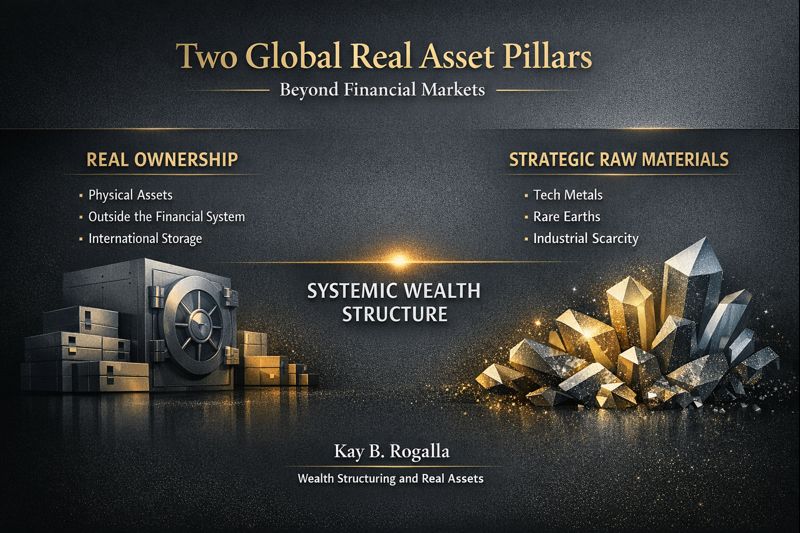
At its core, this approach represents a deliberate shift away from paper-based claims toward genuine ownership, combined with an intelligent allocation to strategic raw materials. Two asset classes that are strong on their own, but whose true effectiveness unfolds only when combined.
Real Ownership Instead of Balance-Sheet Promises
Many investors believe they own assets, but in reality they merely hold claims. Fund units, certificates, bonds, or synthetic structures function only as long as all counterparties meet their obligations.
The system described here takes a different approach. At its center is physically existing, clearly attributable ownership. No issuer risk, no bank balance sheet exposure, no dependence on trading hours or liquidity promises.
These assets exist independently of financial institutions and remain intact even when markets come under pressure or rules change. This is precisely why they have been used by international investors for decades and exhibit an extremely low correlation to equities, real estate, precious metals, or cryptocurrencies.
A Key Aspect That Is Often Overlooked
Based on available market observations, we are not aware of any market phase over the long-term observation of past decades in which this asset class recorded a negative overall performance. Neither financial crises, currency reforms, nor geopolitical disruptions have led to a lasting loss in value to date. In addition, these assets do not correlate with traditional capital markets, are held outside the financial system, and—when structured appropriately—can allow for significant inheritance-tax relief.
International Storage and Maximum Substance Security
Storage takes place outside traditional banking structures in international bonded warehouses with high security standards, including locations in Switzerland. These facilities have been established for decades and are considered among the most stable environments for substance-based wealth protection. The assets are clearly documented, physically present, and unambiguously allocated to the owner. They are not subject to direct access from the banking system, carry no risk of administrative misappropriation, and therefore remain substance-based even in extraordinary economic scenarios.
At the same time, this structure meets the requirements of Sharia-compliant investments and adheres to high ethical standards. No income is generated through interest, no debt relationships exist, and no speculative derivatives are involved. Value development is based exclusively on real demand, cultural relevance, and global acceptance.
Tax and Legal Classification with Long-Term Perspective
Depending on structure and holding period, additional advantages may arise. Capital gains can be tax-free after the statutory holding period when structured privately. In estate planning, these assets can be cleanly integrated and, under certain conditions, transferred with significant tax advantages. What matters is not the product itself, but the structure. The origin of capital, holding period, storage location, and integration into the overall asset framework determine which effects are actually achievable.
The Second Layer That Exceptionally Enhances the Previously Described Core Asset: Strategic Raw Materials. Not Just a Few, but a Total of 16 Different Ones.
While real ownership provides stability, decoupling, and value preservation, the second layer adds strategic depth to the system.
Many investors are familiar with gold and silver. Some additionally consider platinum or palladium. Professional investors go further. They invest selectively in raw materials that are indispensable for industry, technology, medicine, and the energy transition.
This is not about short-term speculation or trend-driven returns, but about structural scarcity. These raw materials are difficult to substitute, globally demanded, securely storable, and limited in their supply. Demand does not arise from fashion or hype, but from technological necessity on a global scale.
Technology metals form the foundation of modern semiconductors, fiber-optic infrastructure, aerospace applications, and energy-storage technologies. Rare earth elements are essential for electric motors, high-performance magnets, and renewable energy systems. Certain precious and specialty metals are used in medical technology, hydrogen applications, and photovoltaics.
All of these raw materials share one thing in common. They are not financial products, but integral components of real value-creation chains. This is precisely why they act as a structural stability anchor within a portfolio.
Why This Combination Is So Effective
Real ownership and strategic raw materials serve different purposes, yet complement each other ideally. One provides substance, value preservation, and legal clarity. The other contributes scarcity, industrial demand, and long-term relevance.
Both asset classes are largely independent of traditional market cycles, react differently than equities or real estate, and operate outside the logic of short-term monetary policy. Only in combination does a wealth structure emerge that does not rely on forecasts, but on physical existence, global demand, and clearly defined ownership.
Conclusion and Clear Classification
This is not about a secret investment or exotic experimentation. It is about a systemic interaction of real ownership, international storage, and the strategic addition of carefully selected raw materials.
Those who seek not only to build wealth, but to decouple it, secure it, and structure it for generations think in exactly this way—quietly, long-term, and beyond the mainstream.
- Two distinct tangible asset classes are strategically combined
- Asset class number one, based on our consolidated knowledge, shows very low correlation, no known negative development, is access-decoupled, and can, under certain conditions, be inheritance-tax efficient. According to the information available to us, value development in certain periods has reached double-digit annual growth rates.
- Asset class number two maximizes risk diversification and return potential within the raw-materials segment, as up to 16 different materials can be acquired under institutional conditions and stored appropriately in bonded warehouses.
- Both asset classes can be broadly diversified individually and in combination, creating optimal conditions for effective rebalancing.
Whether—and in what form—this solution is suitable always depends on individual wealth circumstances, tax structuring, origin of capital, and personal objectives.
This is where information separates from real strategy. For further insights and a deeper understanding of the specific advantages of each asset class, we are happy to engage in an online exchange and look forward to scheduling an appointment.
“Only education about wealth enables the creation of wealth.”
For deeper reflections and practical examples, you will find further content in my podcast at podcast.kay-rogalla.de
Kind regards,
Kay B. Rogalla
Share the knowledge now, HERE!
Disclaimer
The information contained in this post is for general education, information, and inspiration purposes. It does not replace individual investment, tax, or legal advice and cannot substitute for personal consultation. Use of the content is at your own risk. Despite careful research, we do not guarantee completeness, accuracy, or timeliness. We accept no liability for any damages or losses that may arise directly or indirectly from the use of the content.
We are not responsible for the content of external links; the operators of these links are solely responsible. If this post contains affiliate links, we may receive a commission for purchases or bookings made through these links—at no additional cost to you. The decision to use these links is entirely up to you. Our content is based on over 20 years of experience and internationally recognized expertise. We work independently—free from sales pressure from banks or insurance companies—and provide you with insights to make informed decisions.
We understand that financial decisions come with responsibility—therefore, we focus on transparency, security, and comprehensible recommendations. Every financial situation is unique. We are happy to explore together how the content can be optimally applied to your personal situation. Simply arrange a non-binding consultation for this purpose.
Our content is tailored to German legal and market conditions. We review international matters separately on a case-by-case basis. We continuously monitor the markets and regularly update our content—often before relevant changes appear in the news.